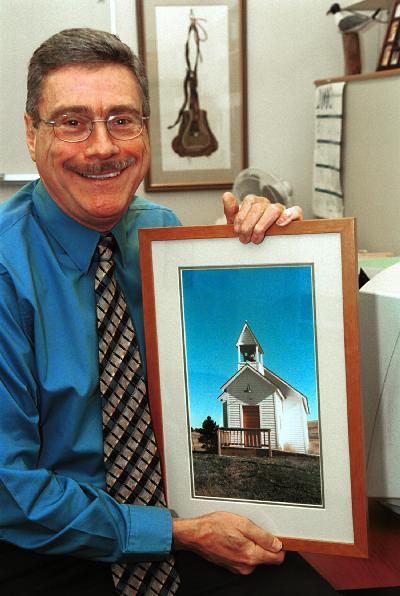
On the wall in Don Wulff鈥檚 office is a framed photograph of a tiny schoolhouse in Montana. That schoolhouse 鈥� now a museum 鈥� was Wulff鈥檚 first experience of education. Back then, he lived on a farm 16 miles from the nearest town with his parents and two siblings. The school was three miles away, and in the winter when the snow made roads impassable, his mother would load the kids on a horse and ride with them to the school.
鈥淪he rode three miles there and three miles back, then did it all over again at the end of the day,鈥� Wulff says.
Later, that same mother fought to have her children attend school in town, then piled them into the car to get them there and back every day.
Mrs. Wulff clearly communicated something about the value of education to her children, two of whom hold doctorates today.
鈥淣either of my parents ever went to college,鈥� Wulff says, 鈥測et they insisted that we get the best education possible and made sacrifices to see that it happened.鈥�
So maybe it isn鈥檛 surprising that Wulff grew up to be first a teacher and then a teacher of teachers. For the past 19 years he鈥檚 been at the Center for Instructional Development and Research (CIDR), the campus organization devoted to helping faculty and teaching assistants be the best teachers they can be. Starting as a graduate student, he has risen through the ranks to become director a year and a half ago.
And recently, Wulff was honored for his commitment to education on a national level. His professional organization, the Professional Organization and Development Network in Higher Education (POD), gave him the Bob Pierleoni Spirit of POD Award, an honor that is essentially for lifetime achievement.
Not bad for a guy who started school in the middle of nowhere and started his teaching career at a high school in Roundup, Montana.
鈥淭hat鈥檚 where I learned to teach, I鈥檓 telling you, when I walked in and had 18 and 19 year olds sitting in my classroom and I was 20,鈥� Wulff says of Roundup. 鈥淚 have a little speech I sometimes give as a guest lecturer. It鈥檚 called 鈥楨ffective Teaching and Learning, or, How to Survive your First Year in Roundup, Montana.鈥� That year broke me in.鈥�
What he learned, he says, is that it鈥檚 not enough for a teacher to be a friend to his students. Rather, it鈥檚 a balance between earning credibility for yourself and having high expectations of them. Only after those things are established can the interpersonal dimension be added.
鈥淭hat was a hard lesson to learn,鈥� Wulff says. 鈥淚t took me one year.鈥�
But he stuck it out, continuing to teach English, speech and drama at Roundup, and then at Missoula, for a total of 16 years. He had earned his master鈥檚 while continuing to teach when he came to a crossroads.
鈥淚 felt as if I鈥檇 given what I had to give to teaching high school,鈥� Wulff says. 鈥淚 wanted to do something for myself, to try to better myself.鈥�
But there were risks involved. In his mid-30s by then, Wulff had a house, a family, retirement funds 鈥� in short, a secure life. Moving to Seattle for a doctoral program at the 91探花would throw a monkey wrench in all that. And Wulff inadvertently made it harder when he fell asleep during the Graduate Record Exam (he鈥檇 been up late working on high school drama production) and earned less than stellar verbal scores. That forced him to enter the graduate program in speech communication without a teaching assistantship.
Undaunted, Wulff set out to prove himself and soon earned his place. He specialized in instructional communication and came to CIDR as a graduate student in 1984, shortly after it had undergone a major restructuring. He鈥檚 been there ever since.
鈥淚 like to tell our new staff and graduate student consultants that I鈥檝e held every consulting role here,鈥� Wulff says.
Some things about CIDR have remained constant since the beginning, and one of those things comes straight out of Wulff鈥檚 dissertation, which was on teaching effectiveness. He interviewed winners of the UW鈥檚 Distinguished Teaching Award in an effort to learn what makes a teacher effective.
鈥淲hat I found out was that effective teachers are able to balance the content, the students鈥� needs and expectations and their own needs and expectations in ways that they can achieve their teaching/learning goals,鈥� he says. 鈥淪o sometimes we talk about balance, sometimes we talk about adaptability, but the whole model has permeated our work here at CIDR. It says there are few answers beyond a given context. You have to find out what the instructor is like, what the students are like and what the content is and then figure out how to help the instructor find the balance.鈥�
One thing that has changed at CIDR, however, is its place at the University. Wulff says that when the center began, the focus on teaching improvement was 鈥渓ike swimming against the current. What made our work especially challenging was the ongoing need to seek an appropriate balance to fit the teaching and research missions of this institution.鈥�
But then, what鈥檚 that to a guy who once rode horseback in the snow just to get to school? Besides, it鈥檚 no longer as true as it once was. 鈥淣ow there are many more people on campus focused on teaching issues,鈥� Wulff says, 鈥渁nd as a result, the need for communication and especially collaboration is absolutely essential.鈥�
The concern of other units with teaching points to the success of CIDR, a success that Wulff has certainly been a big part of. But he won鈥檛 take the credit for that 鈥� or even for his career achievement award 鈥� alone.
鈥淭he CIDR staff are fantastic,鈥� he says. 鈥淲e added up the years of experience they have and it鈥檚 something like 95 years among six people. I really see this Pierleoni award as representing not just what I do but what they do too.鈥�