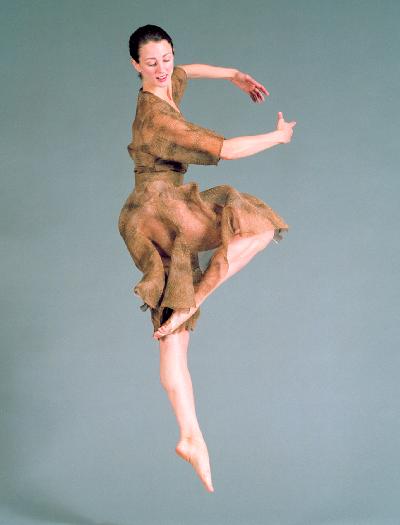
The world of dance may be overwhelmingly female, but the world of choreography is overwhelmingly male. That鈥檚 why the Chamber Dance Company concert Feb. 6鈥�9 is a bit unusual. It features a program entirely made up of dances created by women.
She didn鈥檛 start out to make a political statement, director Hannah Wiley says. Rather, her first impulse was to finally win the right to perform a dance called Kiss by Susan Marshall.
鈥淚鈥檝e been trying to get that dance for about eight years,鈥� Wiley says. 鈥淓very year I write to her to ask if we can perform it and every year she says no. Once, about three years ago she said yes but changed her mind. This year she said yes. So that was my first thought for the concert.鈥�
Like copyrighted pieces of literature or music, dances can only be performed with the permission of the choreographer, Wiley explains. The company usually pays a fee for the use and royalties on the performances.
After she obtained Marshall鈥檚 work, a colleague brought Wiley鈥檚 attention to a 1938 dance by Eve Gentry called Tenant of the Street. And shortly thereafter she was watching a tape of work by Bebe Miller and found one of the dances, Cantos Gordos, striking.
鈥淪o I ended up having three pieces by women and I saw the potential of its being all-women,鈥� Wiley says. She rounded out the program with Debussy Dance, a piece by Hannah Kahn that she herself had performed in about 25 years ago and Davenport Memoirs, by local choreographer Llory Wilson.
Reconstructing dances from a choreographer鈥檚 repertoire usually involves bringing the choreographer or her representatives in to work with the company, and that鈥檚 what happened in this case. Eve Gentry died a few years ago, but a woman who had learned the dance from her came to set it on the Chamber Dance Company. Bebe Miller and Hannah Kahn came themselves, while Susan Marshall sent two of her dancers, and has since watched videos of the performance as it has developed. Because she is local, Llory Wilson has been able to continue her work with the dancers through rehearsal.
For the non-resident choreographers, Wiley learns the dances 鈥渇rom the outside鈥� by watching them while the choreographer is present and works with the dancers afterward to achieve what the choreographer is after. It鈥檚 also her responsibility to 鈥渃lean鈥� the dance, meaning she works on precision of movement, so that, for example, everyone鈥檚 arms are at the same angle when they are supposed to be.
Wiley says it鈥檚 not possible to plan a dance concert solely on the basis of the choreographers鈥� gender, race or nationality. The dances themselves have to go together to make a pleasing evening, and that鈥檚 what she had in mind when she chose the five pieces. Now that she鈥檚 watching the concert in rehearsal, however, she feels it reflects 鈥渁 certain way of looking at the world鈥� that is the result of the choreographers being women.
鈥淭here鈥檚 a level of compassion and interest in relationships and human interaction,鈥� she says. 鈥淓ven Hannah Kahn鈥檚 dance, which is completely abstract 鈥� no story at all 鈥� feels so gracious and allows the dancers to be in such a vulnerable place. I don鈥檛 think that鈥檚 limited to feminine expression, but when you have five women lined up together I think it hits home more strongly.鈥�
Wiley doesn鈥檛 think the rarity of women choreographers is standard sexism. It鈥檚 more a matter of the numbers.
鈥淚t鈥檚 because so many little girls from age 2 or 3 on want to become ballerinas and only a tiny fraction of them get to have a career,鈥� she says. 鈥淥n the other hand, a male who shows any talent at all will get a job just like that. It鈥檚 easy to abuse women if there鈥檚 a plethora of them.鈥�
The women represented in the concert, Wiley says, started their work at a time when women in dance were beginning to speak out again after a period of few strong voices. 鈥淭hey鈥檙e strong, smart women 鈥� a crop of women who felt empowered by their education and on equal ground with men.鈥�
The six-member Chamber Dance Company, all of whom are graduate students in dance, will perform in the concert. One undergraduate dance student will appear in one of the pieces. The concert is set for 8 p.m. Thursday through Saturday and 2 p.m. on Sunday. Tickets are $14 ($10 for students and seniors) and are available at the 91探花Arts Ticket Office, 4001 University Way N.E. For further information about dance and other arts events on campus, go to www.artsuw.org.