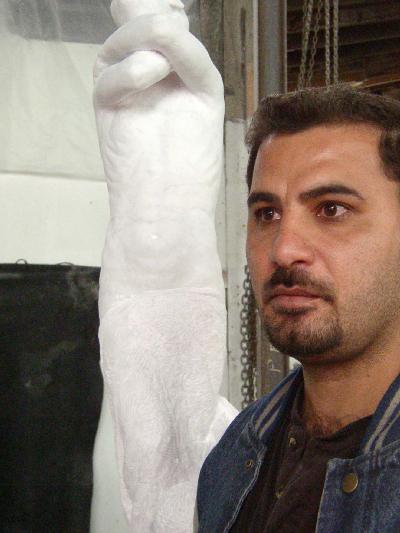
He was there during the 1991 uprising against Saddam Hussein鈥檚 iron-fisted government. He revolted, was captured, jailed and tortured before escaping. He hasn鈥檛 spoken with his family since three weeks before the United States launched its most recent war on Iraq. He doesn鈥檛 even know if his mother and 10 siblings are dead or alive.
Yet the message Sabah Al-Dhaher wants to share is this: He鈥檚 not so different from you. None of us, really, are all that different.
鈥淧hysically, emotionally, we are one,鈥� Al-Dhaher said recently from his Interbay sculpting studio, a world away from the Iraqi desert where he grew up. 鈥淣o matter how different we are in terms of our culture, we are so similar in our souls. We should focus on that. The world would be a lot safer and a lot more peaceful if people would start thinking that way.鈥�
Several of Al-Dhaher鈥檚 sculptures have been showing in an exhibition at the UW鈥檚 Odegaard Undergraduate Library since January. They are scheduled to remain in the library until the end of the year.
A black three-ring notebook filled with blank white pages has been placed near his artwork in Odegaard. Visitors have penned their thoughts on the pages, giving the exhibition an interpersonal feel that Al-Dhaher greatly values. That need for a human connection in his artwork has also inspired him in his work with a group of Jewish and Arabic children in Seattle.
Al-Dhaher got involved with the Sculpting for Peace project when his friend, Amineh Ayyad, a research coordinator in Health Sciences and a volunteer for the Arab Center of Washington, invited him to work with the children to create a sculpture representing peace. When the work is eventually completed it will be donated to the Seattle Center, where it will be permanently displayed in the peace garden.
鈥淪eeing the world through these children鈥檚 eyes gives us an important new perspective. We鈥檙e just trying to get the children to work together, to be friends,鈥� Al-Dhaher said.
He hopes the experience in his studio will help them grow to respect others regardless of their cultural background.
He has plenty of motivation to seek a more peaceful world.
Al-Dhaher knows first hand about the brutality Hussein鈥檚 regime employed to control the people of Iraq. After the first gulf war he rebelled along with thousands of Shiites. The effort failed after American troops pulled out of the country and Al-Dhaher and others were imprisoned, tortured and often executed.
He endured the torture. He watched as young boys would get pulled from a line of prisoners and taken away. They鈥檇 return bloodied and bruised, their faces swollen.
鈥淚 felt so sorry for him, but at the same time I didn鈥檛 want to be in his shoes,鈥� he recalled thinking during one terrifying session. During his imprisonment in Iraq Al-Dhaher hoped for a quick, painless death that never came.
After 11 days he was removed from the jail and ordered to return to his hometown of Nasiriyah where he was to report to the chief of police. Instead, he said goodbye to his family and fled to the border where he convinced American troops that he was a member of the Iraqi army and wanted to surrender. He was arrested and sent to a prison in Saudi Arabia, where he lived in relative peace for two years.
After getting his release he and several of the other prisoners refused to go back to Iraq, telling prison officials they feared they would be killed by Hussein鈥檚 forces. Their status was changed from prisoner of war to refugee and that paved the way for Al-Dhaher鈥檚 move to Seattle.
鈥淭here was someone else in the camp, a poet, who went to Seattle. So I chose Seattle too.鈥�
Within two weeks of arriving he met the woman who would become his wife. They fell in love while communicating through an English-Arabic dictionary. Together they have a son and, in many ways, they live an almost typical American life, worrying about childcare, paying the bills and running errands in their Chevy mini-van. But much of their time and energy these days is spent waiting for word from Al-Dhaher鈥檚 family in Iraq.
鈥淭hat鈥檚 one of the most frustrating things right now for me, not to know,鈥� he said. 鈥淚t鈥檚 hard when you鈥檙e expecting something bad to happen. The waiting for something bad is harder than knowing about it. I feel like it would be a lot easier for me if I knew who was dead and who was alive. Then I could deal with it instead of just wondering.鈥�
His artwork and his teaching 鈥� he鈥檚 an instructor at the Pratt Fine Arts Center in downtown Seattle 鈥� have helped relieve some of the tension. One piece in particular, has been a refuge for Al-Dhaher. The untitled and unfinished sculpture shows a man鈥檚 body looking skyward as it ascends from another body, which lies in a heap on the ground. A woman鈥檚 figure grabs at the man as if trying to hang on as the soul departs.
鈥淪he鈥檚 grabbing at the spirit and trying to stop it, trying to stop the death from happening,鈥� he said. 鈥淎t the same time, she knows that she can鈥檛 do that.鈥�
He can鈥檛 be sure what the message behind the sculpture is, he just knows the woman is the focal point.
鈥淔emales always, no matter what culture, they鈥檙e always taken for granted. There鈥檚 a death in the family, there is a loss, the females do grieve, just as the males, but with the females we expect them to also keep going on and take care of the family. No matter what culture, we always do that. Or maybe it鈥檚 just my way of thinking about war. It鈥檚 a man鈥檚 game. Women are the ones left to pick up the pieces.鈥�
His interest in art began as a young boy, when he was working in his father鈥檚 bakery. A friend in their neighborhood heard that he was interested in drawing and gave him a book about art. In those pages Al-Dhaher first saw the work of Michelangelo.
鈥淚 was fascinated.鈥�
Then the friend gave him a copy of The Odyssey. Those influences are still visible in his work today. He draws inspiration from both Greek mythology and the sculptors of the Italian Renaissance. But in these times his inspiration is almost a protective reflex, he says.
鈥淭o me, art, first, is a survival thing. It keeps my soul clean and my spirit alive. You know, when you go through a difficult life, being in prison, being almost executed, being tortured, it鈥檚 easy for your soul to be destroyed, for your spirit to be destroyed. You have to have something, some hope that will keep you going. I think art did that for me, does that for me. It has kept me thinking in a positive way.鈥�