What are you afraid of?
That鈥檚 the question the graduating class of the Professional Actor Training Program is asking in its new production, Panaphobia, which opens next week. Created in collaboration with visiting artist KJ Sanchez, the show was derived from interviews with ordinary people who were asked to talk about their fears.
But this isn鈥檛 a documentary, a la Anna Deavere Smith, creator of such starkly real pieces as Twilight: Los Angeles 1992. Nor is it a typical narrative. Sanchez describes it as a 鈥渃ollage.鈥� She said the audience will hear monologues spoken by 12 actors portraying five times that many characters, juxtaposed with music and scenes to create a kind of progression.
This collaborative method of making theater is one that Sanchez is very familiar with. She鈥檚 a member of a theater group in New York called The Civilians that has used just such a process in its productions. And three years ago, she worked with the PATP in a collaborative production called Too Much Water.
But while Ophelia鈥檚 story from Hamlet was the basis for that production, Panophobia had only a theme, not a story, so the group decided it needed a structure to work with. 鈥淲e had studied Joseph Campbell鈥檚 book, Hero with a Thousand Faces, and decided we would follow his road map in our play,鈥� Sanchez said. 鈥淲e have a hero who receives a call to adventure, initially refuses the call, then accepts it, struggles and eventually finds a way out.鈥�
In Panophobia, the hero will be standing on a platform above the other actors and will remain there throughout the play. He is a sort of mystery figure whose true role will not be revealed until the end.
|

As for the others, their lines come directly from interviews collected by members of the cast and crew. The interviews, Sanchez said, used a method pioneered by playwright Caryl Churchill and her theater company in England. Interviewers asked a pre-decided list of questions and simply listened to the answers. They were not allowed to use a tape recorder or a notepad. After the sessions, interviewers wrote down, in first person, as much as they could remember of what was said.
The cast and crew then gathered, and each person got up and recited the words of the people he or she had interviewed. The group strove for as diverse a collection of interviewees as possible, Sanchez said. They talked to black men who were afraid of police and police who were afraid of their own uncertainty in knowing who the criminals were. They talked to a woman who was afraid of water and another who was afraid of the African Americans in her neighborhood.
鈥淚鈥檝e been surprised by how compelling each person interviewed is when you see them as an individual,鈥� Sanchez said. 鈥淲hen you see them as individuals, rather than as a representative of a group, there鈥檚 understanding.鈥�
Once the interviews were gathered the group went through a winnowing process, deciding which ones would be part of the show. They used the Joseph Campbell road map to decide where to place each one.
Some evidence of the process can be found at the Playhouse Theatre, where a room off the lobby contains bits of paper posted on every wall. 鈥淲e called this the writing room,鈥� Sanchez explained. 鈥淭his is where we talked about our interviews and the ideas we had for them and tried to decide what to keep and what to throw out. We did storyboards for all the possible scenes.鈥�
It took three weeks to finalize the shape of the show as rehearsals went on. Sanchez had nothing but praise for the PATP actors. 鈥淭hey鈥檝e been really game and have picked up this process quickly,鈥� she said.
Doing a show about fear is something Sanchez said she had been thinking about for a long time, spurred on by Barry Glassner鈥檚 book, The Culture of Fear, which maintains that Americans are full of misplaced fear that prevents them from focusing on what really matters.
But Panophobia isn鈥檛 all serious. Some of the group, for example, got interested in horror movies and the idea of fear as entertainment. That became fuel for the show鈥檚 songs and dance numbers.
鈥淲e were watching the 1950s movie The Blob and found out that Burt Bacharach wrote the music for it,鈥� Sanchez said. 鈥淚t鈥檚 so fun and kitschy and cocktail hour.鈥�
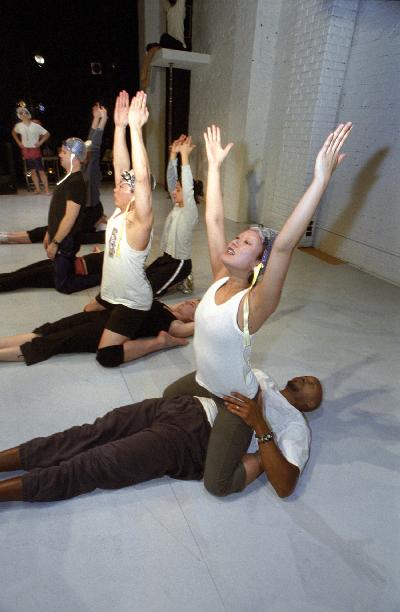
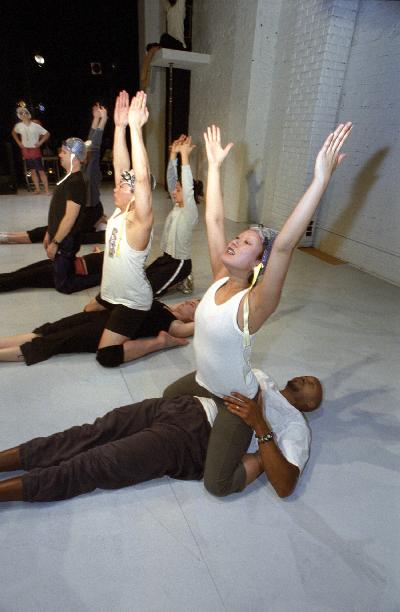
One of the production鈥檚 dance numbers is done to Bacharach鈥檚 鈥淭he Blob.鈥� It starts off with a man on the ground and several people around him outlining his body as if he鈥檚 dead. Then the music comes on and he arises and it turns out he鈥檚 actually the Blob.
The monologue by the woman who鈥檚 afraid of water is followed by a swimming ballet with the whole cast in swim caps and goggles. Fear of flying is portrayed through a dance number on ropes.
All the music comes from the 1950s, a time period Sanchez said she chose because on the surface America was a perfect society but beneath that were dangerous undertones.
Sanchez said though she started with a book that was critical of American society, she didn鈥檛 want the play to be preachy. 鈥淚 was more interested in just the human experience of living in our time and place,鈥� she said. 鈥淚 also wanted to celebrate what is so uniquely American in this subject. I wanted to honor the delight we sometimes get from scaring ourselves. And I wanted to ask, 鈥榃hen is fear a good thing?鈥� 鈥�
Following Joseph Campbell鈥檚 road map calls for an ending that shows the way out, an answer that the group didn鈥檛 want to impose. 鈥淩ather than us coming up with some phony guru kind of solution, there were several interviews that show people who are finding a way out,鈥� Sanchez said. 鈥淥ur play doesn鈥檛 say how to overcome fears, but it points to people who are living their lives in an inspirational way.鈥�
This is the first time Sanchez has done a production with this theme, but she said she鈥檇 like to do it again 鈥� in New York or possibly here in Seattle.
鈥淚t鈥檚 an interesting journey I鈥檝e had with it because I started off, you know, (thinking of) Michael Moore, Bowling for Columbine and Glassner 鈥� there鈥檚 a lesson to be learned, we have to teach America and we need to move beyond our fears,鈥� she said. 鈥淏ut in the end I found myself just wanting to respect and appreciate the humanity involved and it鈥檚 very hard for us as little human beings to navigate our way through our culture right now.鈥�
Panophobia opens April 11 and runs through the 25. Showtimes are at 7 p.m. weekdays, 8 p.m. Friday and Saturday and 2 p.m. on Sundays. Tickets are available at the Arts Ticket Office, 206-543-4880.