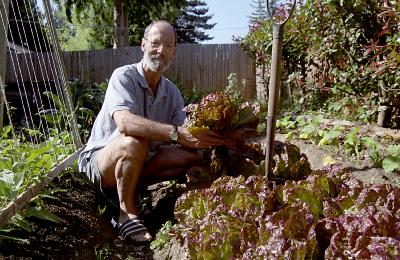
Shortly after Ian Taylor arrived in Seattle in 1975, he got a job at the UW. He also started his first garden. Now, nearly 30 years later, he鈥檚 still working at the University and still gardening. Next week he鈥檒l be sharing some of his experiences with the latter when he reads from his first book, Suburban Adventures of a Naked Gardener.
Naked? Well, not all the time. But more about that later.
The book, which Taylor will read from at 7 p.m. Tuesday, June 29, at the University Bookstore, is a collection of his gardening columns from the Seattle Tilth newsletter. Seattle Tilth (the word means cultivation) is an organization devoted to promoting organic gardening practices and opposing the use of pesticides, herbicides and chemical fertilizers. Taylor says he began writing the columns largely because he has a sense of humor.
鈥淪eattle Tilth is an earnest organization whose values and purposes I strongly and thoroughly support, but I think we could lighten up a little bit,鈥� he says. 鈥淓arnest people with passionate views aren鈥檛 very amusing. In fact, they can tend to get boring. They can tend to get hard to listen to. So when I proposed the column to the editor, I had in mind something that would add a lighter touch to the newsletter and give us a chance to be amused 鈥� not only at everybody else, but at ourselves.鈥�
So he writes about his hen that likes to defy gender roles and crow at daybreak; he writes about an ultimate Frisbee that 鈥� when he retires from the sport 鈥� turns out to be the perfect container for separating wheat from chaff; and he writes about a worm bin gone bad that produces 鈥渟lugs the size of zucchini, spiders the size of hamsters!鈥�
It鈥檚 easy to see why people enjoyed the columns enough to suggest to Taylor that he should publish them in book form 鈥� a suggestion he mulled over for quite some time before finally deciding to follow through. Self-promotion, he explains, isn鈥檛 really his style.
Taylor began writing the column in 1991 and continued for five years. Then, after a three-year hiatus, he resumed in 1999. The book, however, covers only the columns from the first five years.
Taylor was, by then, gardening on his own land, but he didn鈥檛 wait for home ownership before working the soil. That first summer in Seattle, back in 1975, he gardened in a P Patch in South Seattle. Then there were a series of rental houses where he struggled to cultivate less than fertile soil.
鈥淓very rental place we lived in, I would break up the soil and start to grow vegetables,鈥� he says. 鈥淚 just love to do it. I love the idea of producing food for the table, as much of it as possible. There鈥檚 something powerfully attractive in producing your own food.鈥�
Of course, Taylor was raised to be a gardener. A native of England, he grew up in a small market town in Leicestershire, where he helped his father grow vegetables. Working in the garden, he says, is something he always enjoyed, even as a kid.
But he isn鈥檛 an employee of the Center for Urban Horticulture or any other garden-related department. In fact, his career is about as far removed from the earth as anything could be. He鈥檚 the manager of the Security Middleware Unit, which is part of Computing & Communications.
Educated originally as a librarian, Taylor started at the 91探花as a temporary clerical employee and picked up computer skills along the way. Now he works in what he calls the identity management field 鈥� all those processes concerned with what people can do online, who they are and what they鈥檙e allowed to see. He calls it 鈥渧ery interesting work,鈥� but says it isn鈥檛 enough.
鈥淲e are equipped 鈥� I鈥檓 convinced about this 鈥� by nature and by our heritage to be multi-talented, multi-skilled, able to do all kinds of things,鈥� he says. 鈥淪ure, we can work in a technological field, but that doesn鈥檛 stop us learning a musical instrument or a foreign language or being really good at dancing or gardening. In fact I think our natures ask that of us. I think we should fulfill as many of our potentials as we can. For me, gardening and writing and composting are some of those areas in which I feel I can express myself and fulfill some of the aspects of my nature that my day-to-day work doesn鈥檛 fulfill.鈥�
There are few things related to gardening that Taylor hasn鈥檛 explored. Almost 20 years ago he went through the second training Seattle Tilth offered to become a master composter.
Afterward, he and a friend taught a composting class for about five years. Composting, he says, is something that simply makes sense. Decayed yard waste turned into compost is beneficial for any soil 鈥� lightening the clay type and improving water retention in the sandy type. And food waste can be safely composted in a worm bin, though occasionally you do get those 鈥渟tinking messes鈥� he wrote about in his book.
Nonetheless, the natural way of doing things is always Taylor鈥檚 preference. He writes in the book, for example, about learning to skin and tan the hides of the moles his cat killed, in hopes of obtaining enough real moleskin to make use of.
And then there鈥檚 that naked gardening bit. Taylor admits that he has on occasion done his gardening au naturel, calling it an attempt to connect with nature.
鈥淭he natural world is so beautiful as long as we don鈥檛 mess it up,鈥� he says, 鈥渁nd it seems to pose questions; it seems to offer something that you can鈥檛 quite receive.鈥� Taking off clothes, he says, is 鈥渓ike removing some of the trappings of the civilized world鈥� so one can better make that connection.
On the cover of his book is a drawing of a (modestly posed) man holding a trowel and wearing only a sunhat and a pair of flip-flops. Is that picture of him?.
Taylor just smiles. 鈥淚t could be.鈥�