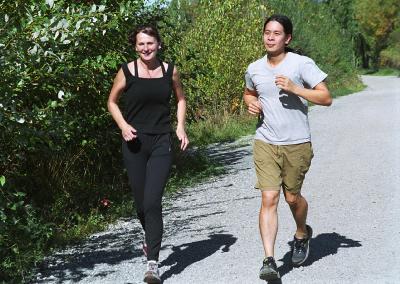
She’d run regularly for 15 years. He did a desultory two-mile run now and then.
He saw her run six miles and thought, “If she can do that, surely I can.” But up till then he’d felt as if he might have a heart attack beyond two miles.
“Try running slower,” she told him.
So he did, and he did the six-mile run. Then he thought, “That was easy.” So he said, “I think I’d like to run a marathon.”
And she said, “I’ll run it with you.”
So they ran a marathon, but that was just the beginning.
He is John Lin. She is Joanna Haug. They’re two 91̽»¨study coordinators (he in Pathology, she in Radiology) who met and became friends while working on a large clinical trial, and it would be an understatement to say they’ve come a long way together. Or perhaps we should say, they’ve gone a long way together.
“We’ve somehow managed to talk each other into getting into these really challenging situations,” Haug says with her clipped British accent.
Lin just laughs in reply. He laughs often, in fact. He’s clearly a guy who doesn’t take life, or himself, too seriously. “It’s when the endorphins kick in,” he says of the running. “That’s when you get all the gargantuan ideas, during the first five miles when you say, ‘Oh, this is so easy. Let’s run a ridiculous amount more next time.’”
“He just comes up with these over-the-top ideas and I say, ‘Oh, yeah, yeah. Whatever you come up with, I’ll do it,’ ” Haug replies.
The two did their first marathon in Yakima in 2002, after training for several months. “We’d run three to four times a week — a few 5 or 10 mile runs and then 15 or 20,” Lin says.
He admits he was nervous about the marathon, worried he wouldn’t be able to do it, but says the experience turned out to be fun, and surprisingly easy. “I thought it would be really challenging — a stereotypical goal to achieve in one’s life. Then it was so easy, so I thought, let’s run a little bit further.”
And they did. In the last year alone they’ve done three ultra marathons — 50k and 50-mile runs done on trails. Quite a bit different from marathons.
Haug describes marathons as a middle class, urban phenomenon full of optimism, cheering crowds, food stands and music. “In the ultra, you’re completely by yourself and nobody cares that you’re out there,” she says. “There’s one food station in 15 miles. And hardly anyone does this. You’re down from a few thousand people in a marathon to 30 in an ultra.”
The first time they did an ultra, near Granite Falls, Lin got lost on what he calls poorly-marked trails and ended up tumbling down a forested slope. “I was worried because I thought I was horribly behind and I couldn’t see any other runners. I ran an extra two miles or something to get back on the proper course. I had cuts all over my legs from the fall.”
But this less-than-joyous experience didn’t deter him, or his faithful companion. “We had more fun at Mt. Si because they have lots of food. They also mark the trail well,” Haug says.
To prepare for the ultra runs, Lin and Haug had to ratchet up their training. Gone were the 10-mile runs, now considered “garbage runs” because they aren’t long enough to do much good. Instead, they’d go out to the mountains and run six hours at a stretch about once a week, which might make you believe they’re dedicated athletes — fanatic about their health. But you would be wrong. When asked if they run for their health, or to keep their weight down, both deny it. Lin even smokes. In fact, he smokes more when they’re in training for a race.
Haug says to Lin, “I don’t like running. I love hiking. I mean, do you like running?”
Lin: “No, I hate running.”
Haug: “That’s why his smoking goes up.”
Lin: “’Cause it’s this horrible dread of running.”
Which leads to an obvious question: Why do they do it?
“It’s just kind of interesting to see what your body can do,” Lin says. “It’s psychological.”
Haug emphasized,“It’s not psychological in terms of using your mind to overcome pain. It’s more changing the way you think about what you can do. Anyone could do it. All you need to do is set out a plan for yourself and execute it. For me it’s all a matter of self discipline. Wherever those physical limits are, I haven’t reached them yet. And I think it’s intriguing at my age — I’m 47 — that I can do more and more.”
Haug is equally intrigued by Lin, who is 31 and able to run a long race with minimal training, despite being mostly inactive the rest of the time. “It’s effortless for him,” she says. “He doesn’t even appreciate how effortless it is. He’s a natural. If he properly trained, he’d be amazing.”
But Lin isn’t setting any major fitness goals. In fact, both friends say they probably wouldn’t continue running at their current pace if either moved away. “We egg each other on,” Haug says. “We get these stupid ideas.”
What Haug does do on her own is walk — at least she sets out to walk. Over the summer she planned a walk across her native England — “the 200-mile skinny part,” she hastens to say. But on the way she ran into some ultra runners who were doing the same route at a 30-mile-per-day pace. She joined them, not because she found the running attractive but because it meant she could put her pack on a support van and get meals provided.
Lin is less ambitious, admitting that walking his dogs is about all the exercise he gets when he’s not preparing for an ultra.
So what’s next for Haug and Lin?
“I’ve been thinking of this run in Oregon,” Lin says. “It’s not longer but it goes along the Pacific Crest Trail. I figure, at least go for better scenery.”
Haug doesn’t believe the part about it not being longer. “Whatever it is, it’ll be twice as big as it was before,” she says. “On principle.”