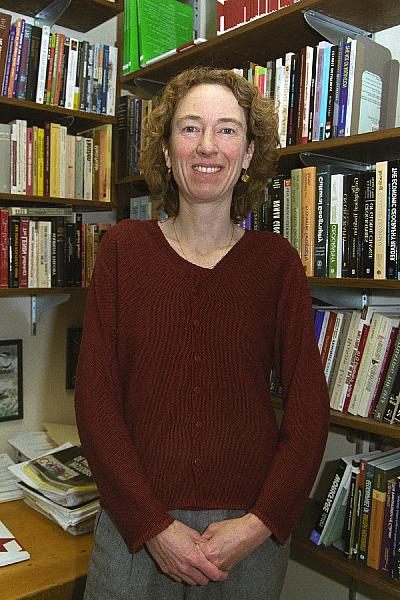
Geography Professor Katharyne Mitchell has been named to a professorship that will give her time to do some concentrated research and writing. But the book she hopes will result won鈥檛 be a scholarly tome designed mainly for other academics. It will be a trade book aimed at the general public.
That鈥檚 because the professorship is the Simpson Professorship in the Public Humanities, a post designed to foster links between the University and the larger community. Mitchell is the first to hold the professorship, funded by the Walter Chapin Simpson Center for the Humanities.
鈥淗aving a professorship like this is something I鈥檝e been wanting to do for a long time because I want to send a strong signal that the public humanities are important,鈥� said Kathleen Woodward, director of the Simpson Center. 鈥淚 broached the subject to Barclay Simpson, who endowed the Simpson center in honor of his father, and he contributed the support through the Simpson PSB (Put Some Back) Fund.鈥�
Mitchell said that the professorship 鈥渞epresents the legitimizing of our roles beyond the academy. It gives more license and indeed enthusiastic welcome to the possibilities of bringing new people into intellectual debates that are going on.鈥�
The intellectual debate that Mitchell would like to enter has to do with childhood. She calls her project 鈥淪tealing Childhood,鈥� arguing that a number of factors are converging to negatively impact the lives of children.
鈥淚n school it鈥檚 the culture of standardized testing and the resulting focus on a rather narrow curriculum,鈥� Mitchell said. 鈥淥utside of school it鈥檚 the loss of play space and the privatization of play space. There are fewer public parks than there used to be, and more places where parents pay to have their children play.鈥�
Stealing Childhood is the title of the book Mitchell plans to write as part of her project, but that isn鈥檛 the only thing she plans to do. She is currently recruiting four other faculty with whom she hopes to form a 鈥渞esearch cluster鈥� as a way to 鈥渆xpand the collaborative process.鈥� The other professors will come from different fields and contribute their expertise to the total project.
One thing Mitchell hopes will be part of that project is a documentary film about K-12 students. She鈥檚 therefore planning to recruit one professor with expertise in filmmaking. But she doesn鈥檛 want to simply make a film about children; she wants the kids to play an active part.
鈥淚 would bring in the students themselves to direct and produce the film with our help. The idea is that they become subjects of the research and not just objects,鈥� Mitchell said. 鈥淚 want them to realize they can be active agents, even if they鈥檙e 鈥榦nly鈥� students. I want them to be reflexive about themselves as the objects of pedagogy and what that means 鈥� to have an understanding of how teaching works and how learning works, so they can start to put themselves in the driver鈥檚 seat.鈥�
The film, Mitchell explained, would be about the students鈥� impressions and experiences of being children in this particular era 鈥� what it鈥檚 like to be tested, like with the WASL, what it鈥檚 like to have their play space be defined in certain kinds of ways, what they feel about scheduling in terms of lessons and various activities, what it鈥檚 like to have Coke or Pepsi in the schools, and so forth. The students would interview each other and take pictures of things that interest them.
鈥淪o it鈥檚 an effort to practice what we preach, which is to say democracy isn鈥檛 something you wait until you鈥檙e grown up to do,鈥� Mitchell said. 鈥淒emocracy is something you learn by working through differences to try to make a better society. And the starting point of that is reflexivity on your position as the object of education and as a subject that can make a difference.鈥�
This isn鈥檛 Mitchell鈥檚 first foray into the K-12 setting. She recently received another grant from the Simpson center that gave associate professors release time to have serious conversations with another professor across disciplines. Mitchell鈥檚 partner in that project was Walter Parker from the College of Education, and from him she gained important contacts in public schools that will help her with the current project.
Mitchell also hopes that the research cluster professors can write a grant to the National Endowment for the Humanities to get support for a related idea she has about forming 鈥渘ew cultural landmarks鈥� as places for teachers to take students to understand our history 鈥� to 鈥済et away from the founding fathers as the only cultural landmark we have.鈥�
The professorship, which is for a three-year term, allows Mitchell to teach two classes a year instead of four, provides some resources for community outreach, additional funds on top of her salary, a nine-month research assistant and a small research fund to buy books or go to conferences. For Mitchell, its most precious gift is time
鈥淚鈥檝e done less in the public humanities than I would have liked,鈥� she said. 鈥淚鈥檝e always felt somewhat constrained by the necessity to publish in academic journals and to teach. Now I feel I can publish for an educated lay audience. In addition to the book, I鈥檇 also like to write magazine articles and to do some speaking.鈥�
Although funding right now is only for Mitchell鈥檚 term of three years, Woodward hopes it will continue with other funding sources. In fact, she recently met with representatives of the National Endowment for the Humanities, suggesting that they create a category of fellowship in the public humanities.
鈥淢ost of the research support in the humanities has taken the form of the sabbatical,鈥� she said. 鈥淭his professorship allows the faculty member to stay on campus. I鈥檇 like to see the 91探花professorship be a model for research that connects with the community.鈥�